
When families inherit 50 to 100 handwritten recipe cards, shipping them off in a prepaid box seems like the simplest route. Commercial scanning companies promise white-glove treatment and museum-grade handling. But before you tape up a box containing the only surviving copy of your great-grandmother’s holiday stuffing recipe, here is what independent reviews and carrier policies actually reveal.
1. Carrier Insurance Does Not Protect Sentiment or History
The biggest misconception about shipping old recipe cards is that buying $500 or $1,000 of postal insurance protects you. It does not:
- Fair Market Value rule: USPS, UPS, and FedEx pay claims strictly based on verifiable commercial market value or reproduction cost.
- Zero monetary worth: To an insurance claims adjuster, a 1948 index card with hand-penciled pie crust notes has zero commercial market value. If a parcel is lost, stolen off a porch, or crushed in a sorting facility, the carrier will only reimburse the replacement cost of a blank 3×5 index card—a few cents.
- Irreplaceable loss: Once a shipping box disappears in a regional sorting hub, no insurance check can bring back your family’s handwriting.
2. High-Speed Feeder Jams and Fragile Vintage Paper
Commercial scanning operations handle thousands of documents daily. To maintain profit margins on low-cost scanning, many facilities run batches through automated document feeders (ADFs):
- Roller tension: High-speed rollers exert mechanical tension designed for modern 20lb printer paper, not 60-year-old wood pulp cardstock.
- Brittle edges and grease soft spots: Recipe cards that spent decades near cooking oil, steam, and butter are softer in some areas and brittle in others. A single dog-eared corner can snag, causing an accordion jam that rips irreplaceable handwriting in half.
3. High Hidden Costs for Raw, Unsorted Scans
Mail-in scanning services rarely transcribe or design anything. You are paying solely for raw digital image files:
| Service Model | 50 Recipe Cards (Double-Sided) | Transcription Included? | Finished Cookbook? | Transit Risk |
|---|---|---|---|---|
| Mail-In Scanning Bureau | $150 – $240 (per-card fees + shipping) | No (Raw image files only) | No (Folder of loose JPEGs) | High (Carrier transit) |
| DIY Scanning Apps | Free (or $4.99/mo app subscription) | No (You type everything) | No (Requires photo book software) | Zero (Cards stay home) |
| Recipe Restore | $79 flat | Yes (100% human transcribed) | Yes (Publication-grade PDF) | Zero (Cards stay home) |
The Zero-Risk Alternative: Smartphone Photos at Your Kitchen Table
Modern smartphone cameras shoot at 12 to 48 megapixels with sophisticated computational color balancing. When photographed under clean daylight, a smartphone photo captures paper texture, ink nuances, and grease marks with stunning clarity.
With Recipe Restore, you take 5 minutes to photograph your 50 favorite cards on your kitchen counter. Your original cards remain safely in your possession at all times.
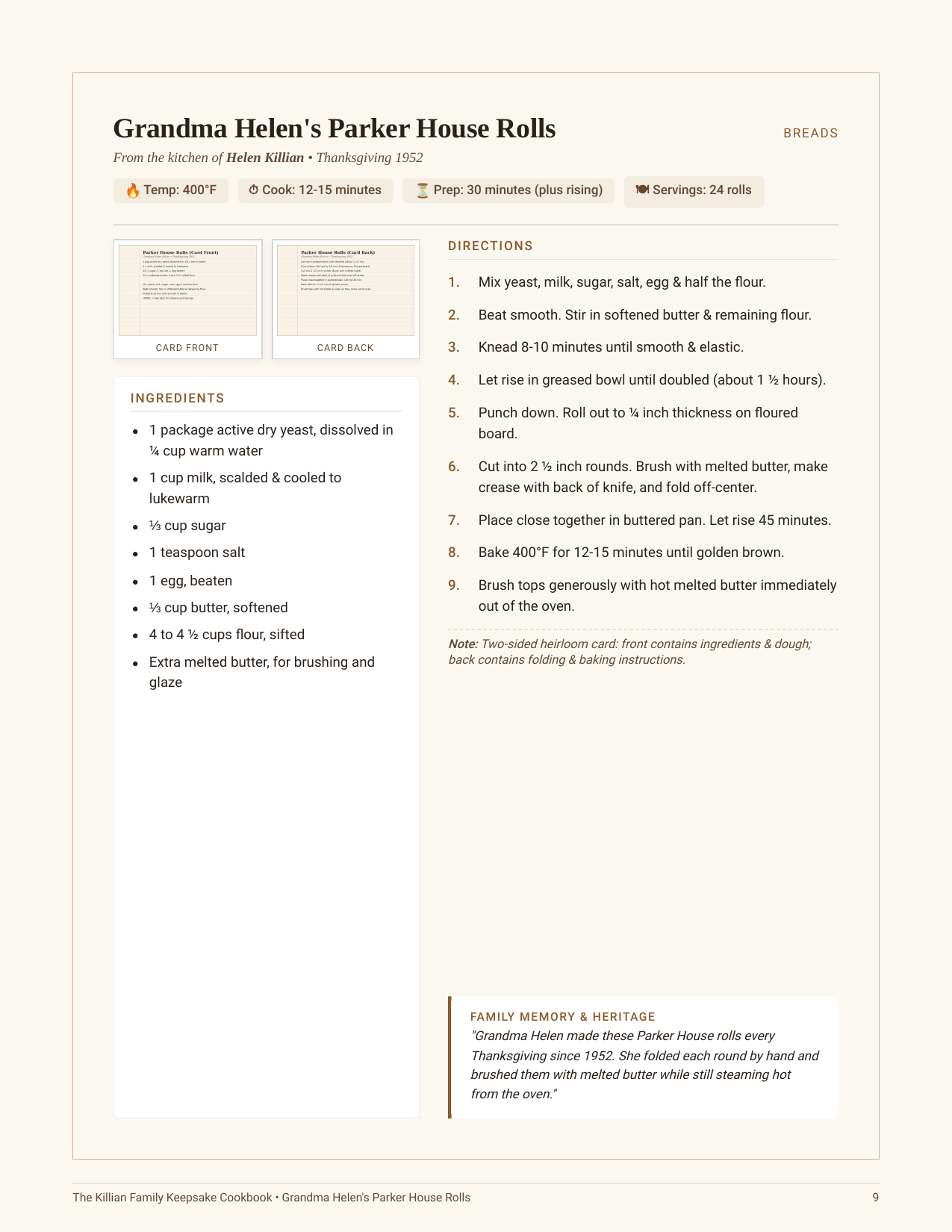
Curious how a finished cookbook looks when built from kitchen-table smartphone photos? Explore the Killian Family 50-recipe sample book reader →
Frequently Asked Questions
Does shipping insurance cover lost family recipe cards?
Do scanning services use sheet-fed scanners on fragile recipe cards?
How much do mail-in scanning services charge for recipe cards?
How does Recipe Restore eliminate shipping risk entirely?
Never risk your family's only copy in the mail
Leave your irreplaceable cards where they belong—safe in your kitchen. Take simple phone photos of 50 recipes, and we will transcribe, verify, and design a publication-ready PDF cookbook for $79 flat.
Start your family cookbook ($79) →