
When you open an inherited recipe tin, you often find cards in varying states of decay: some are bright and crisp, while others have turned dark yellow, with faint ballpoint handwriting that has nearly disappeared into the paper.
Paper does not decay randomly. Paper degradation is driven by biochemical reactions that can be completely halted with standard museum storage protocols. Here is how archival conservators protect paper collections for generations.
1. Eliminate Light Exposure to Halt Ink Fading
Ultraviolet (UV) radiation from sunlight and fluorescent bulbs is the primary enemy of vintage ink:
- Ballpoint ink vulnerability: The synthetic dyes used in mid-century ballpoint pens (popularized in the 1950s) break down quickly when exposed to visible light and UV rays, fading from deep blue or black to faint lavender or yellow.
- The complete darkness rule: Original handwritten cards should live in 100% darkness. Displaying original cards in photo frames on bright kitchen counters or refrigerator doors will cause noticeable fading within 12 to 24 months. Frame a photographic reproduction instead.
2. Control Climate: The 68°F / 40% Humidity Standard
The two most dangerous places to store family heirlooms are the attic and the basement:
- Attic heat (Chemical acceleration): For every 18°F (10°C) increase in temperature, the rate of acid hydrolysis in paper doubles. Summer attic temperatures reaching 110°F bake wood-pulp cards, causing them to turn yellow and snap like crackers.
- Basement dampness (Mold & foxing): Relative humidity above 65% triggers mold growth and accelerates rust-colored fungal spots known as foxing.
- The golden zone: Store your collection on a top shelf of an interior hallway or bedroom closet. Keep the room between 65°F and 70°F with 30% to 50% relative humidity.
3. Choose the Right Storage Enclosures
What touches your paper matters as much as where it sits:
- Buffered Archival Boxes: Look for archival boxes marked acid-free, lignin-free, and buffered with 2% to 3% calcium carbonate. The alkaline buffer actively neutralizes acids emitted by vintage wood-pulp paper.
- Archival Polypropylene or Mylar Sleeves: Enclosing each card in an unplasticized sleeve prevents oil and sweat from fingers from transferring onto the card when browsing.
- Avoid raw wooden boxes: Raw cedar or pine boxes release volatile organic acids (lignin vapors) that accelerate paper yellowing. If you use a wooden box, line the interior with acid-free barrier paper.
The Permanent Solution: Retire the Originals, Cook from a Book
The ultimate preservation dilemma is that keeping cards in archival boxes keeps them safe, but nobody in the family gets to cook Grandma’s recipes. Bringing 70-year-old paper back into a kitchen filled with boiling pots, grease splatters, and flour invites accidental ruin.
Recipe Restore provides the perfect bridge. You take phone photos of your 50 favorite cards on your kitchen table. We transcribe the handwriting, balance measurements, and design a custom, publication-grade PDF cookbook that your entire family can cook from freely.
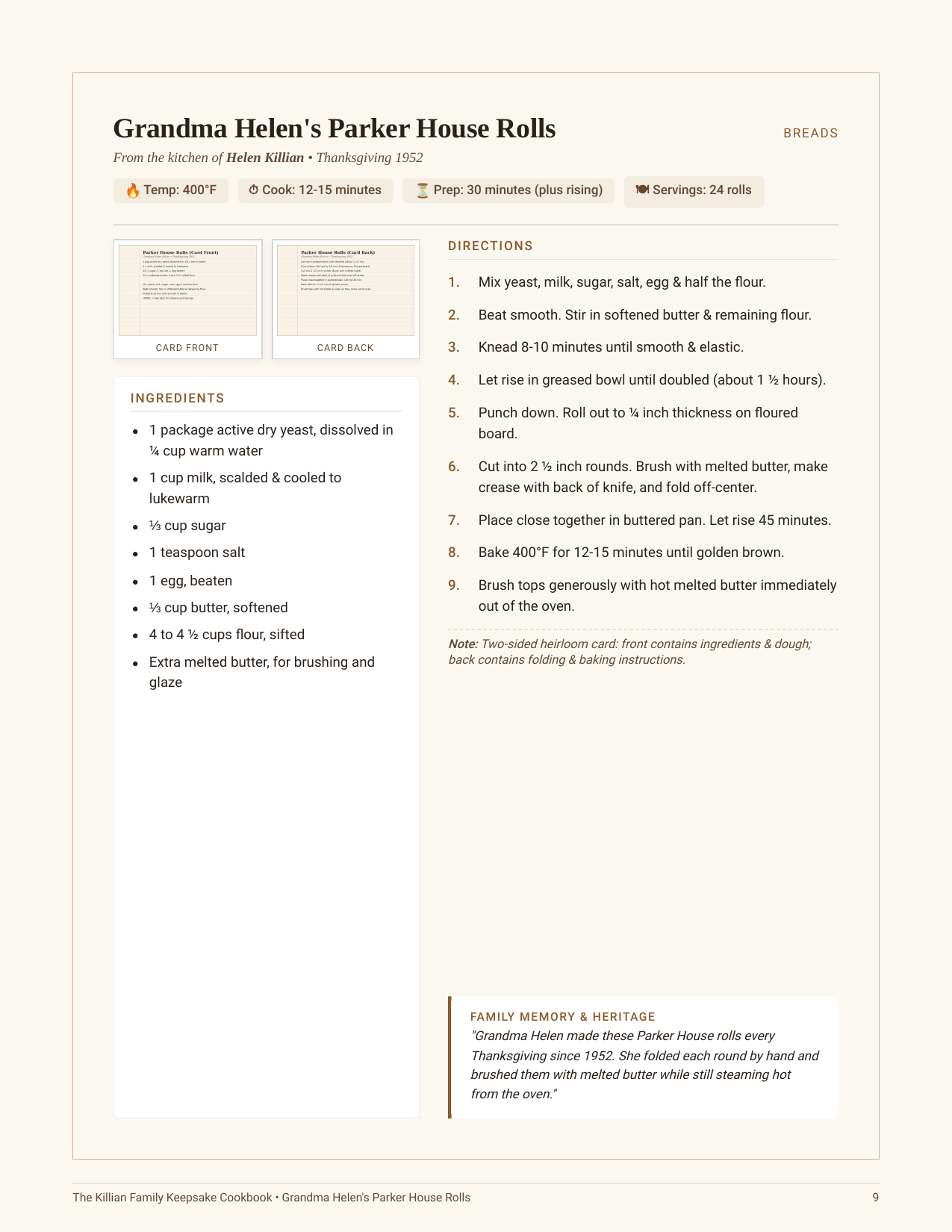
Curious how original handwriting is preserved alongside clean kitchen recipes? Explore the Killian Family sample cookbook reader →
Frequently Asked Questions
Is it safe to store vintage recipe cards in an old metal tin?
Why do old recipe cards turn yellow and brittle?
Can faded ballpoint or pencil handwriting be restored on paper?
Where in my home is the best place to store old recipe cards?
Protect your originals and share the recipes with everyone
Store the delicate cards safely away from kitchen hazards. Send us phone photos of 50 family recipes, and we will transcribe, standardize, and design a publication-ready heirloom PDF cookbook for $79 flat.
Start your family cookbook ($79) →